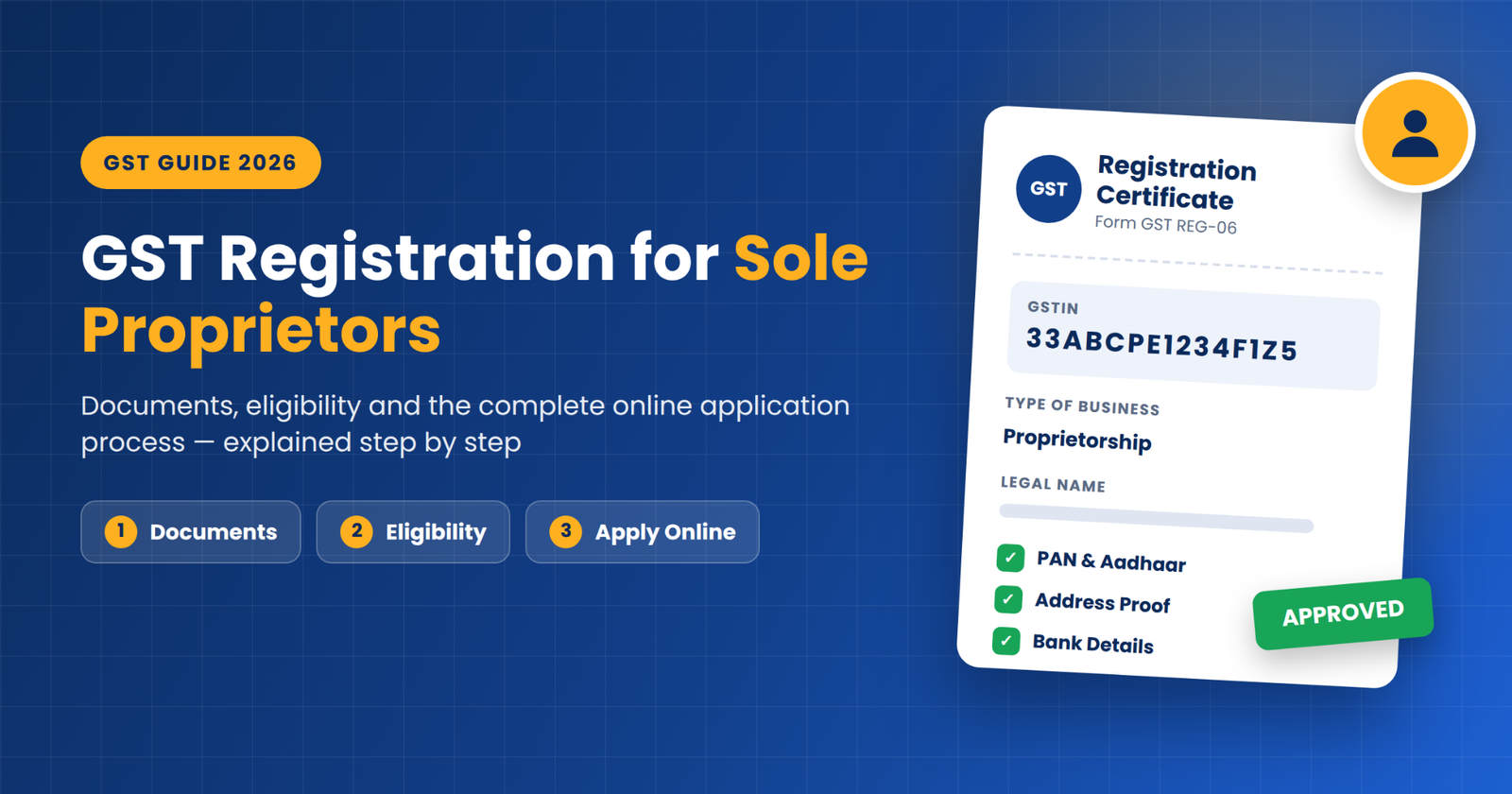
GST Registration for Sole Proprietors : You started with a modest venture. Perhaps it is a home-based bakery, a freelance design practice, or a trading business with your name on the signboard. Then a client asks for a GST invoice, or a marketplace requires your GSTIN, and you realise that you may need to register.
For an individual running a business in their own name, sole proprietorship registration is not a one-time formal process. Instead, the proprietor obtains the registrations and licences applicable to the nature of the business, its activities and location. GST registration is one of these requirements when the business becomes liable under GST.
What Does Registration Under GST Mean for a Sole Proprietor?
GST registration is the process of registering a business with the Goods and Services Tax system. Once approved, the proprietor receives a 15-digit GSTIN (Goods and Services Tax Identification Number) linked to the proprietor’s PAN and the State or Union Territory of registration.
A registered taxpayer can collect GST from customers where applicable, issue GST tax invoices and claim input tax credit (ITC) subject to the applicable conditions.
A sole proprietorship registration online is an individual who owns and operates the business. Since a proprietorship does not have a separate legal personality from its owner, the proprietor’s PAN is used for GST registration.
The main provisions governing registration are contained in Sections 22 to 30 of the CGST Act, 2017, along with the relevant provisions of the CGST Rules.
Who Must Register? Eligibility and Threshold Limits
A proprietor generally becomes liable for GST registration when the business crosses the prescribed aggregate turnover threshold. Certain categories of taxpayers may also be required to register irrespective of turnover under Section 24, subject to specific exemptions and notifications.
For the general threshold applicable to many businesses:
| Type of Supply | General Threshold | Specified Lower-Threshold States/Categories |
| Goods only | ₹40 lakh | ₹20 lakh |
| Services or mixed supplies | ₹20 lakh | ₹10 lakh |
The applicable threshold depends on the nature of supplies, the State or Union Territory and the relevant notifications. It is therefore important to check the rule applicable to the particular business before relying only on the turnover figure.
What is Aggregate Turnover?
Aggregate turnover is calculated on an all-India basis for persons having the same PAN. It generally includes taxable supplies, exempt supplies, exports and inter-State supplies, while certain amounts, such as GST itself and inward supplies on which tax is payable under reverse charge, are excluded.
For example, if you operate a shop and a consultancy business under the same PAN, the turnover of both businesses is considered while determining aggregate turnover.
When Can Registration Be Compulsory Irrespective of Turnover?
Section 24 covers specified categories that may require compulsory registration, including:
- Persons making specified inter-State taxable supplies
- Casual taxable persons and non-resident taxable persons
- Persons liable to pay tax under reverse charge in specified circumstances
- Persons required to deduct or collect tax under GST
- Input Service Distributors
- Agents making taxable supplies on behalf of other taxable persons
- Certain suppliers making supplies through specified e-commerce operators
There are also statutory exemptions and notified relaxations for particular categories. For example, the GST framework contains specific provisions affecting small suppliers using e-commerce platforms. Therefore, the nature of the supply and the e-commerce operator’s GST obligations should be checked before deciding whether registration is mandatory.
If registration becomes mandatory, the application is generally required within 30 days from the date on which the liability arises.
Did You Know? The turnover test is based on aggregate turnover under the same PAN, rather than looking at each business or shop in isolation.
Sole Proprietorship Registration and GST: What Do You Need First?
A proprietorship does not receive a separate incorporation certificate like a private limited company or LLP.
Instead, the proprietor’s PAN, GST registration where applicable, Udyam registration and state or local registrations can establish and support the business depending on its activities.
Here is how the common registrations line up:
| Registration | Mandatory or not | Purpose |
| PAN of the proprietor | Yes | Base identity for tax and GST registration |
| GSTIN | When the business is liable under GST or voluntarily registers | Collect GST where applicable, issue tax invoices and claim eligible ITC |
| Udyam Registration | Generally voluntary | MSME registration and access to applicable benefits |
| Shops & Establishment / Trade Licence | Depends on State/local rules | Local operating requirements |
| Current bank account | Business practice | Business banking and receipt of business payments |
For many businesses, a GSTIN can also serve as supporting evidence of business activity when dealing with customers, marketplaces, banks and other institutions.
Documents Required for a Proprietor’s GSTIN Application
The documents required can vary depending on the business premises, authentication method and circumstances. Common documents include:
| Document | Details |
| PAN card | Proprietor’s PAN |
| Aadhaar | Used for authentication where applicable |
| Passport-size photograph | Photograph of the proprietor |
| Address proof | Proof of the principal place of business |
| Rent agreement | Where the premises are rented |
| Consent letter/NOC | Where the premises belong to another person |
| Bank proof | Cancelled cheque, passbook or bank statement, where required |
| Mobile number and email | For OTP and application communication |
Checklist Before You Begin
- PAN details are correct
- Aadhaar details are available for authentication
- Aadhaar-linked mobile is active where Aadhaar authentication is used
- Address proof is current and contains the required details
- Bank details are available as required
- HSN/SAC codes for the goods or services are identified
- The proprietor’s business and contact details are ready
Online Application Process: Step-by-Step
GST registration can be applied for online through the official GST portal. The application is broadly completed through Part A and Part B of Form GST REG-01.
Step 1: Open the GST Portal
Visit the GST portal and select:
Services → Registration → New Registration
Step 2: Complete Part A
Select Taxpayer, choose the relevant State or Union Territory and enter:
- Legal name as per PAN
- PAN
- Mobile number
- Email address
Step 3: Verify OTPs
Verify the mobile number and email address through OTPs. A Temporary Reference Number (TRN) is generated for continuing the application.
Step 4: Complete Part B
Log in using the TRN and provide details such as:
- Trade name
- Constitution of business — Proprietorship
- Reason for registration
- Principal place of business
- Additional places of business, if applicable
- Goods and services supplied
- Bank details
- Proprietor/promoter details
Step 5: Upload Documents
Upload the required documents and photograph. Eligible applicants can also select the applicable Rule 14A option.
Step 6: Complete Aadhaar Authentication
Complete Aadhaar authentication through the process provided on the GST portal. Some applicants may be required to undergo biometric authentication at a designated facility.
Step 7: Submit the Application
The application can be verified and submitted using the applicable electronic verification method. A proprietor does not ordinarily need a Digital Signature Certificate merely because the applicant is a sole proprietor.
Step 8: Note the ARN
After successful submission, an Application Reference Number (ARN) is generated. Use it to track the application status.
Step 9: Respond to Any Query
If the proper officer raises a clarification or document query in Form GST REG-03, respond through Form GST REG-04 within the prescribed period.
If approved, the GST registration certificate is issued in Form GST REG-06.
Aadhaar or Biometric Verification
Some applications may be selected for biometric-based authentication. Where the GST system requires this, the applicant must follow the instructions communicated through the portal and complete the required authentication within the prescribed time.
Timeline at a Glance
| Stage | What Happens | Indicative Time |
| Part A | PAN, mobile and email verification; TRN generated | Usually a few minutes |
| Part B | Business details and documents completed | Depends on applicant |
| Aadhaar authentication | OTP or biometric process, where applicable | Depends on authentication |
| ARN | Application submitted | Generally immediate after successful submission |
| Approval | Application processed by the department | Depends on verification, risk parameters and whether a query is raised |
Actual processing time can vary where biometric verification, clarification, document issues or officer queries are involved.
Simplified Registration Under Rule 14A
Eligible small taxpayers may use the simplified registration mechanism under Rule 14A, subject to the prescribed conditions.
One of the key conditions is that the applicant’s monthly output tax liability on supplies made to registered persons must not exceed ₹2.5 lakh. The applicant must also satisfy the other conditions prescribed under the rule and complete the required Aadhaar authentication.
Where the applicant qualifies and the application passes the applicable checks, the GST registration can be granted electronically within three working days under the prescribed mechanism.
Important Point
The ₹2.5 lakh condition refers to output tax liability on supplies to registered persons, not simply monthly sales.
For example, if a proprietor makes ₹6 lakh of B2B taxable supplies in a month at an 18% GST rate, the output tax on those supplies would be approximately ₹1.08 lakh before considering other applicable adjustments. The proprietor would therefore need to assess the Rule 14A conditions using the prescribed tax-liability test rather than comparing ₹6 lakh directly with ₹2.5 lakh.
If the applicant later ceases to satisfy the conditions of the simplified route, the prescribed withdrawal/conversion procedure must be followed.
GST Registration Fees and Time Taken
- Government fee: There is no government fee for applying for GST registration through the GST portal.
- Professional fee: A CA, tax professional or service provider may charge separately for preparing and filing the application.
- Rule 14A route: Eligible applications may be processed within the prescribed three-working-day framework.
- Regular applications: Processing depends on verification and whether the application requires clarification, additional documents or biometric authentication.
There is no guaranteed approval timeline because the application remains subject to the GST registration process and departmental verification.
Regular Scheme vs Composition Scheme for Proprietors
A proprietor who becomes liable for GST should also consider which taxation scheme is appropriate.
The regular scheme generally permits eligible taxpayers to claim input tax credit and make inter-State outward supplies, subject to the applicable GST provisions.
The composition scheme is a simplified taxation option for eligible small taxpayers, but it comes with restrictions, including restrictions on input tax credit and certain types of outward supplies.
| Feature | Regular Scheme | Composition Scheme |
| Input tax credit | Available subject to conditions | Not available |
| Tax collection from customers | GST charged through tax invoice, where applicable | Tax cannot ordinarily be collected separately from customers |
| Inter-State outward supplies | Permitted subject to GST rules | Generally restricted |
| Compliance | Regular GST returns | Simplified compliance with prescribed forms |
| Tax rate | Applicable GST rate | Prescribed composition rate |
For goods, the general composition turnover limit is ₹1.5 crore, subject to State-specific provisions. A separate composition option is available for eligible service suppliers up to the prescribed ₹50 lakh turnover limit, subject to its conditions.
The right option depends on the nature of the business, customer profile, input-tax position and expected turnover.
Compliance Checklist After You Get Your GSTIN
After registration, a proprietor should:
- Display the GSTIN as required on the business premises and relevant documents
- Add the GSTIN to applicable tax invoices
- Maintain proper books and GST records
- File the applicable GST returns within the prescribed due dates
- Pay GST through the applicable electronic cash or credit ledger
- Reconcile eligible input tax credit with the relevant GST records
- Keep supporting invoices and other records for the statutory retention period
- Update business and bank details when required
- Respond to GST notices and departmental communications within the prescribed time
Even where there are no taxable transactions for a particular return period, a registered taxpayer may still need to file the applicable nil return.
Failure to file returns can lead to late fees, interest and, in appropriate cases, cancellation or other action under the GST law.
Penalties, Common Mistakes and Pros and Cons
Penalty for Not Registering
If a person is liable to register but fails to do so, the GST law provides for penalties and recovery of applicable tax and interest. The amount depends on the nature of the default and the relevant statutory provision.
A proprietor should therefore determine registration liability before beginning taxable business activity where GST registration is required.
Common Mistakes to Avoid
- Entering legal details that do not match PAN records
- Uploading incomplete or unsuitable address proof
- Failing to complete Aadhaar or biometric authentication when required
- Ignoring turnover from other businesses under the same PAN
- Confusing the Rule 14A output-tax-liability test with sales turnover
- Choosing the composition scheme without checking its restrictions
- Missing GST return due dates after registration
- Failing to respond to GST queries within the prescribed time
- Using incorrect HSN or SAC classifications
- Treating GST registration as a substitute for other registrations required under State or local laws
Pros and Considerations
| Potential Benefits | Ongoing Responsibilities |
| Claim eligible input tax credit | GST return filing |
| Issue GST tax invoices | Tax payment and reconciliation |
| Serve customers who require GST invoices | Record maintenance |
| Access marketplaces or B2B opportunities where GST registration is required | Compliance costs |
| Make eligible inter-State taxable supplies | Timely response to GST notices |
Conclusion
GST registration for a sole proprietor depends on the business’s turnover, nature of supplies and the specific compulsory-registration provisions that apply.
Before applying, check the applicable threshold, whether Section 24 or a notification makes registration compulsory, and whether your business qualifies for any exemption. Keep your PAN, Aadhaar, address proof, bank details and business information ready before starting the application.
Eligible small taxpayers may also consider the Rule 14A registration route, but the prescribed conditions must be satisfied and the ₹2.5 lakh B2B output-tax-liability test should not be confused with sales turnover.
Remember that Sole Proprietorship Registration is not a single incorporation process. The registrations required for a proprietorship depend on the nature of the business, its activities and the location where it operates.
If you are unsure whether GST registration is mandatory or which scheme applies to your business, a tax professional can review your business activity, turnover and customer profile before you apply.
Why Choose Zolvit?
- Chartered Accountants for GST registration and tax-related guidance
- Legal professionals for GST notices and related legal matters
- Company Secretaries for wider business compliance requirements
- Document checks before filing
- Support with the online application process
- Assistance with GST compliance after registration
Ready to Get Your GSTIN?
Share your business details and documents with Zolvit’s tax experts to understand whether GST registration applies to you and complete the application through the GST portal.
Apply with Zolvit today and take the next step towards GST registration.
Frequently Asked Questions
1. What is the GST turnover limit for a sole proprietor?
For many businesses, the general threshold is ₹40 lakh for suppliers exclusively dealing in goods and ₹20 lakh for suppliers of services or mixed supplies, subject to the applicable State, notification and statutory conditions. Lower thresholds apply in specified cases.
2. Can a sole proprietor get a GSTIN without a shop or office?
Yes. A proprietor can use a residential property as the principal place of business if the premises satisfy the GST registration requirements and appropriate address proof is available. The exact documents depend on whether the premises are owned, rented, shared or occupied with the consent of another person.
3. How long does it take to get a GSTIN?
Eligible applicants using the prescribed Rule 14A route may receive registration within three working days, subject to the conditions and verification requirements. Other applications can take longer where clarification, document verification or biometric authentication is required.
4. Is there any government fee for a GSTIN application?
No government fee is charged for applying for GST registration through the GST portal. A professional may separately charge a service fee for preparing, filing or following up on the application.
5. Can a sole proprietor opt for the composition scheme?
Yes, an eligible sole proprietor can opt for the composition scheme if the applicable turnover and other conditions are satisfied. The scheme has restrictions, including limitations on input tax credit and certain outward supplies. The general turnover limit for the goods composition scheme is ₹1.5 crore, while an eligible service-provider composition option has a ₹50 lakh limit.
Also Read : GST Registration Turnover Limit in India: When Does a Small Business Need GSTIN?








MAHI
Hello friends! My name is Mahi and I am the Founder & Writer of CashStark.in. I write content related to Blogging, Technology, Make Money, and Education. Hope you like my articles!